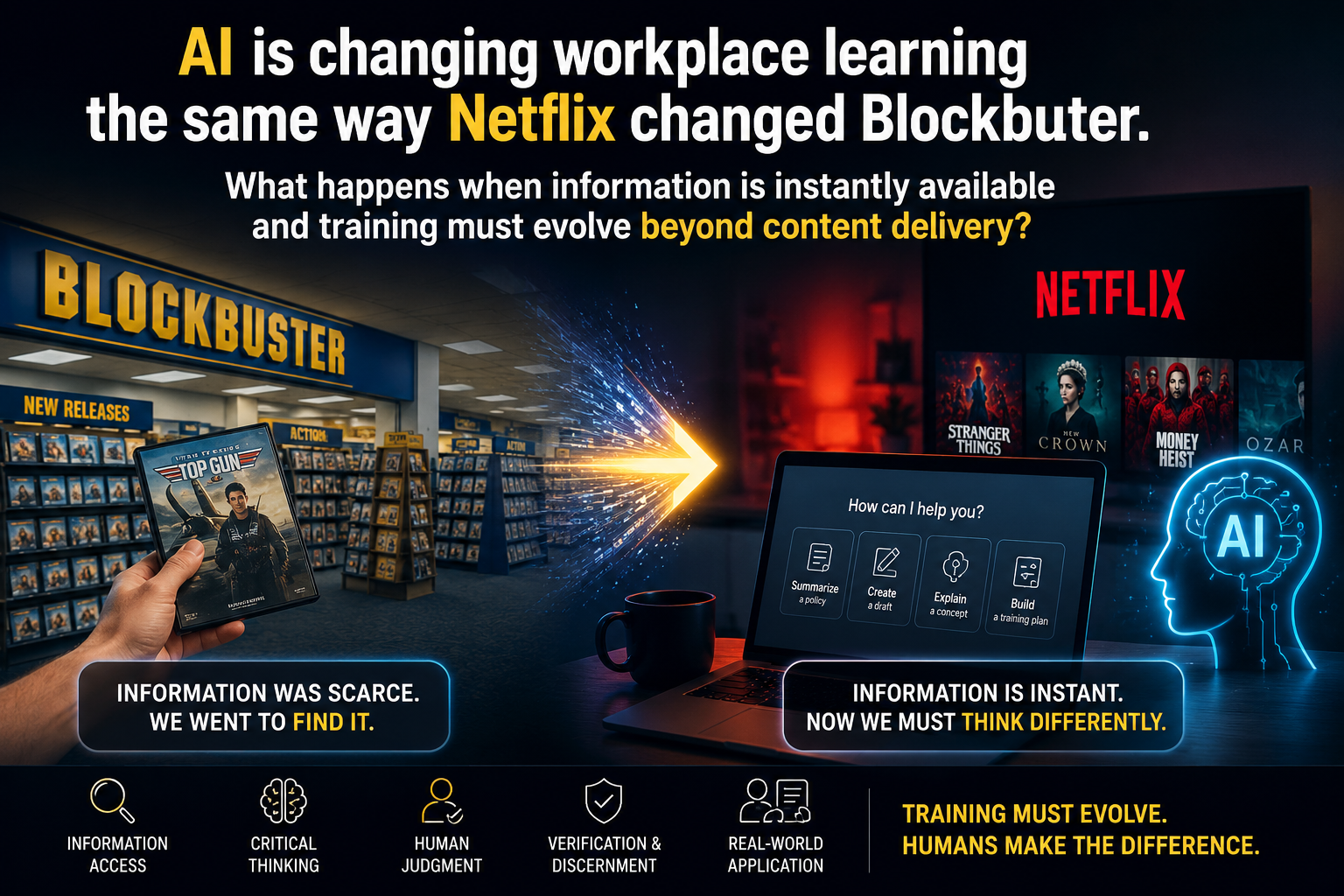
Do you remember Blockbuster? Friday nights featured blue-carpet sticky VHS boxes and some guys standing in a drama section, holding up Top Gun like it was an independent film nobody had ever heard of before, exclaiming, “Dude, you’ve got to see this.”
Click the play button if you prefer to listen to this blog.
Fast forward to when Netflix showed up. My friend Kenny told me he received a DVD in the mail that he could keep as long as he needed and then send it back when he wanted. I was like, “Why would you do that?” I like to go pick out my movies. He was like, ” Yeah, but the late fees are a bitch.”
True! True!
See, what Netflix did is they didn’t simply change how movies were delivered, they changed the entire behavior surrounding movies. Suddenly, the waiting disappeared. I mean, waiting for the movie to come back in for some dude to run it through a rewind machine. Browsing changed: you could browse through tens of titles by looking at images on a screen instead of physically touching boxes—and the way movies were recommended changed, too. The entire system of distribution changed. Physical stores became irrelevant, and then consumer expectations shifted permanently.
But the movie was still a movie, at least at first.
The system around the movie completely changed. The way people consumed the movie changed. It’s hard to explain this to a young person who’s never known the experience of going to a physical location to choose a movie to bring home to watch.
This is where we are in AI right now as it relates to learning and training.
How AI Is Changing Corporate Learning and Training
Most organizations still think they are just adding DVDs in the mail. They are standing inside a Blockbuster, wondering why fewer people are walking through the door. Here’s the truth, the real truth: AI changed the value of information.
For decades, corporate learning has been built on one core idea: if employees know the information, they can do the job.
So, when I got into education and then corporate training, it was filled with building interactive, multimedia courses within LMS libraries, based on PowerPoints and PDFs. The entire corporate training industry was designed to deliver information to people.
But now?
Information has been completely socialized or democratized. Thought to myself: Maybe it would have been better to make a comparison between Napster and the music industry, but perhaps that’s another blog for another time.
What Happens When Employees Can Ask AI Anything?
Employees can now ask AI how to do something, summarize a policy, write a draft, explain a concept, create a checklist, brainstorm ideas, rewrite a communication, build an outline, and make a PowerPoint. Virtually any task that they need to do related to a computer can be done by AI in a matter of seconds. As they say on Reddit, prove me wrong.
Here’s the question: what exactly is training and learning supposed to be now?
We still need people to learn how to do things. Training doesn’t disappear; learning becomes something different that we’ve yet to figure out.
Back in my teaching days, I used to advocate for critical thinking, judgment, good communication skills, discernment, verification, and interpretation. These values are what make us human. They will always separate us from a trained algorithm that can do tasks in a matter of seconds.
This is where organizations start getting nervous.
Workplace Learning Was Knowledge Transfer
Because AI is exposing a truth many companies ignored for years: A lot of workplace learning was really just knowledge transfer pretending to be performance improvement.
That worked when information was scarce.
It works less when ChatGPT sits next to every employee like a caffeinated intern that reads the internet overnight.
Now, before the AI evangelists start sweating through their “Prompt Engineer” hoodies, let me be clear:
AI is incredibly useful.
I use it constantly.
But the organizations that win won’t be the ones with the most AI tools.
They are going to be the ones that redesign how people:
- think
- work
- access knowledge
- collaborate
- make decisions
Because here’s another issue nobody talks about enough: Most organizational knowledge is a disaster.
Somewhere right now inside your company:
- An outdated SOP lives in SharePoint
- Three different departments have three different versions of the same process
- Karen from operations knows how the system actually works, but retires in eight months
- Nobody has updated the onboarding materials since “The Office” was still airing new episodes
Then leadership says, “Let’s connect AI to our knowledge systems.”
The organizations that figure this out early will look wildly different.
The Human Skills AI Still Cannot Replace
Training will become less about dumping information into people’s heads and more about helping employees:
- think critically
- apply judgment
- validate outputs
- solve problems
- work with AI responsibly
Will this happen? Will managers evolve?
A manager’s job could become, “Can Chris think effectively with AI?”
AI Is Changing What It Means to Be Capable at Work
Wow! If managers ask those questions, it would be a massive shift. Honestly, we are probably still early in understanding how big this change really is. Right now, most organizations are still at the “Hey, everybody, AI can summarize meetings!” phase. That’s the equivalent of: “Hey everybody, Netflix mailed me a DVD!”
Meanwhile, the entire system underneath is quietly changing.
And many companies have yet to realize it.
AI is not just changing training.
It is changing what it means to be capable at work.